Mythology & Language
What Does “Achilles’ Heel” Mean?
“Achilles’ heel” means a single, decisive weakness in someone or something that is otherwise strong. The expression comes from a later version of the Greek myth in which the hero Achilles was invulnerable everywhere except the spot where his mother held him while dipping him in the River Styx.
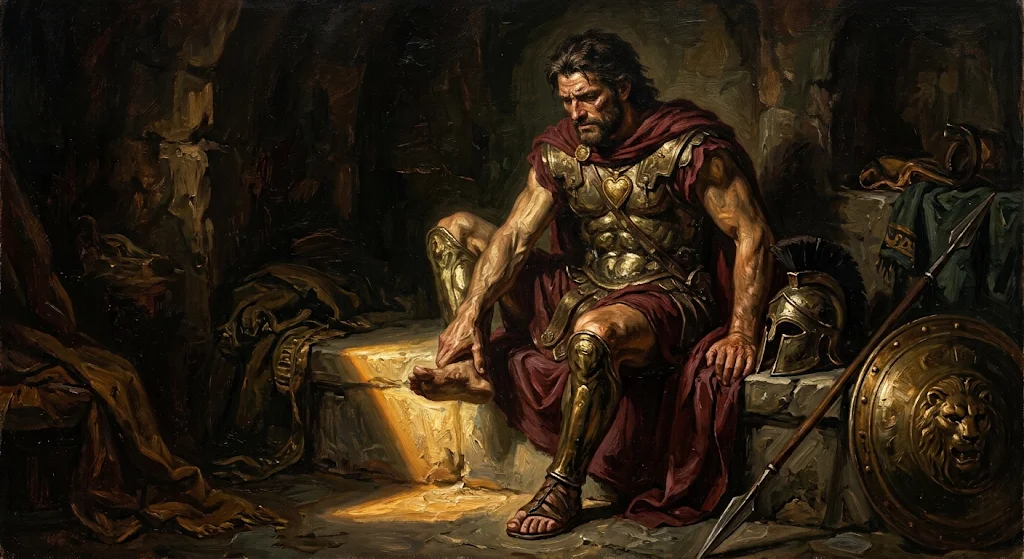
The Myth of Achilles’ Vulnerable Heel
Achilles was the greatest Greek warrior in the Trojan War. His mother, the sea-nymph Thetis, wanted to make him immortal. In the familiar later version of the myth, she dipped the infant Achilles into the River Styx, the river of the underworld. She held him by one heel, leaving that small spot untouched by the river’s protection.
Years later, during the Trojan War, the Trojan prince Paris shot Achilles with an arrow. In the best-known telling, it struck his vulnerable heel and killed him.
Why the Phrase Took Hold
The image is memorable: a nearly invincible hero brought down by one overlooked point. Today, an “Achilles’ heel” can be a person’s, organization’s, plan’s, or system’s critical vulnerability—not necessarily a physical flaw.
For example, “The company’s Achilles’ heel is its dependence on one supplier” means that reliance is a weak point that could undermine the entire business.
The Heel Story Is Later Than You Might Think
The vulnerable-heel episode does not appear in Homer’s Iliad, the central ancient account of Achilles in the Trojan War. Ancient depictions of Achilles’ death sometimes show an arrow wound in his torso as well as his heel, suggesting that the familiar heel-only version developed later.
The earliest clear written account of Achilles being dipped in the Styx is usually traced to the first-century AD Roman poet Statius and his unfinished epic, the Achilleid. Some scholarship also argues that Roman sources placed the vulnerable spot at the ankle, particularly at the talus bone, rather than at the heel as it is usually imagined today.
From Myth to English Idiom
The expression entered English as a metaphor much later than the ancient myths. In 1810, Samuel Taylor Coleridge used a related image, calling Ireland “that vulnerable heel of the British Achilles.” The established idiom is generally dated to 1840.
The legend also inspired the name of the Achilles tendon, the strong tendon connecting the calf muscles to the heel bone. This anatomical name reflects the myth rather than an ancient medical description.
In short, Achilles’ heel began as a later elaboration of a heroic myth and became one of the most enduring metaphors for a critical weakness.
Frequently Asked Questions
Does Homer mention the River Styx in the Iliad?
The Styx appears in Homeric poetry, but the story of Thetis dipping Achilles into it to make him invulnerable is not told in the Iliad.
Who killed Achilles?
In the familiar myth, the Trojan prince Paris kills Achilles with an arrow during the Trojan War. The details vary among ancient and later accounts.
How did the Achilles tendon get its name?
It was named after Achilles because the tendon connects to the heel, the vulnerable spot in the later version of his myth.