Science & Ancient History
Archimedes and the “Eureka!” Moment
The story of Archimedes and his famous cry of “Eureka!” blends a royal puzzle, a sudden insight, and the origins of a principle in hydrostatics. Though the details come from a later account, the anecdote has endured as one of the best-known stories about a scientific discovery.
The Problem: King Hiero’s Crown
The legend is set in third-century BCE Syracuse, in Sicily. King Hiero II had supplied a goldsmith with a specific mass of gold to make a sacred votive crown for the gods. The finished crown weighed exactly as much as the gold provided, but the king suspected the goldsmith might have kept some of the gold and replaced it with an equal weight of a cheaper metal, such as silver.
Hiero wanted to test the crown without damaging or melting it. He turned to Archimedes, the mathematician and inventor who served as his scholar and advisor, to find a way to investigate its composition.
The Breakthrough in the Bath
Archimedes knew that silver is less dense than gold: for the same weight, silver occupies more volume. A crown mixed with silver would therefore take up more space than a pure gold crown of equal weight. The challenge was measuring the volume of an irregular object.
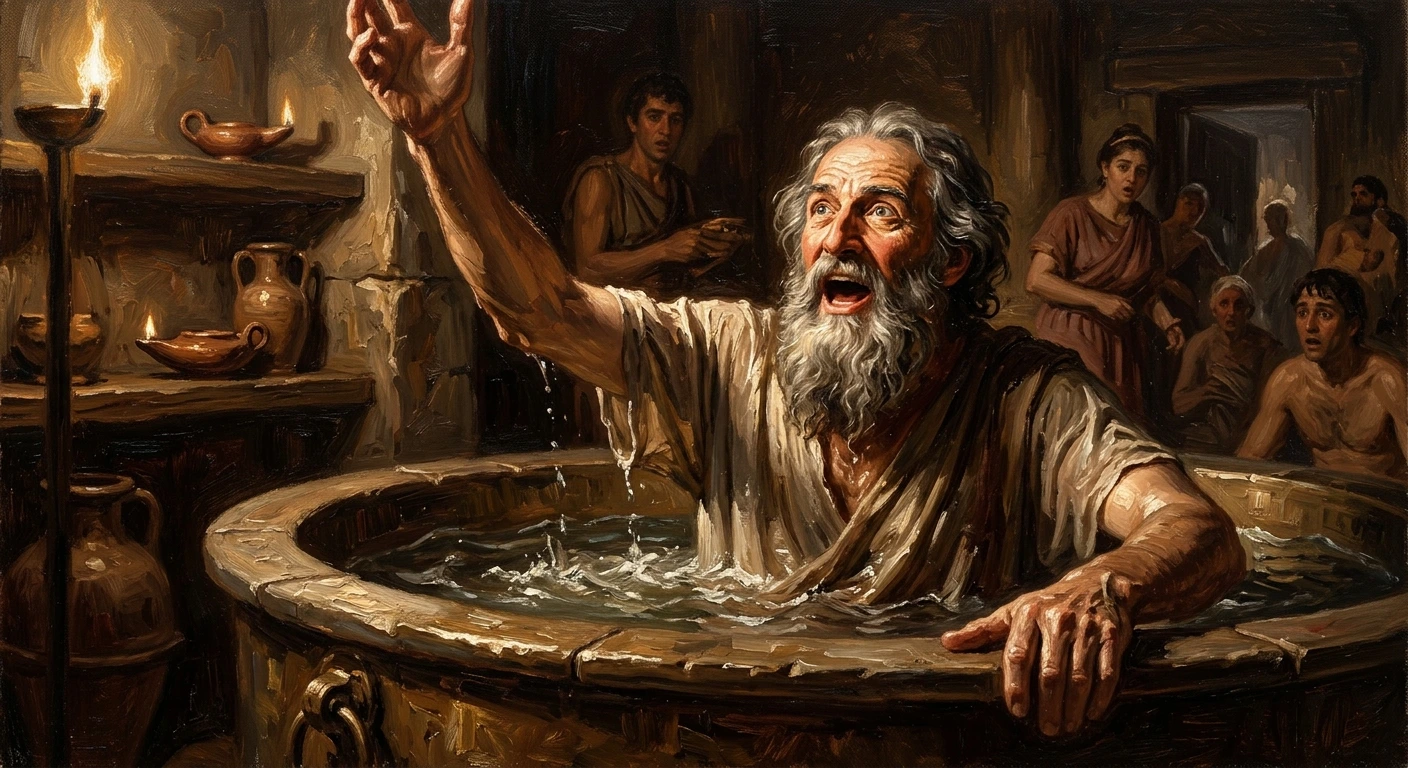
According to the Roman architect Vitruvius, the insight came when Archimedes stepped into a bath filled to the brim and noticed water spilling over its edge. He realized that the displaced water corresponded to the volume of the submerged part of his body.
The story says that, overcome by excitement, he leapt from the bath and ran through the streets of Syracuse shouting “Eureka! Eureka!” Greek for “I have found it!”
Testing the Crown
In Vitruvius’s account, Archimedes compared the crown with equal weights of pure gold and silver by immersing them in water and comparing how much water they displaced:
- He took a gold sample and a silver sample, each equal in weight to the crown.
- He immersed the samples in water and compared their displacement. Because silver is less dense, it displaced more water than the equal-weight gold sample.
- He tested the crown in the same way. In the story, it displaced more water than the pure gold sample, suggesting that it contained a less-dense metal.
This is the famous version of the test; it is not certain that Archimedes performed the experiment exactly as Vitruvius described.
History and Legend
Vitruvius is the source of the bath and crown story, writing centuries after Archimedes lived. Later thinkers, including Galileo, questioned whether measuring a small difference in overflow from a heavy crown would have been precise enough with the equipment available at the time.
Archimedes may instead have used a more precise hydrostatic balance, comparing apparent weights in water. The account is debated, and the exact method he used, if any, to test the crown is not known.
The broader scientific idea is buoyancy: a body immersed in a fluid experiences an upward force equal to the weight of the fluid it displaces. This principle is associated with Archimedes and became foundational to hydrostatics.
What Does “Eureka” Mean Today?
“Eureka” is still used as an exclamation when someone finds the answer to a difficult problem or makes a sudden discovery. Whether or not Archimedes ran through Syracuse as the legend says, the story captures the excitement of recognizing a solution and the lasting power of a good idea.