Philosophy & Metaphysics
The Ship of Theseus: A Paradox of Identity
The Ship of Theseus (also known as Theseus’s paradox) is a classic philosophical thought experiment in metaphysics and identity theory. It questions whether an object that has had all of its components replaced remains fundamentally the same object.
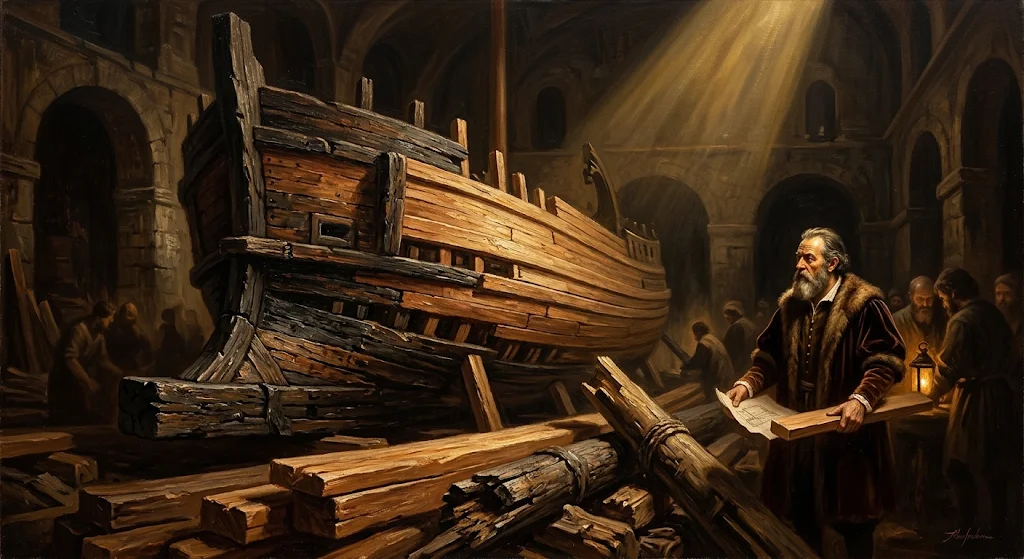
The Origin Story
The puzzle comes down to us through ancient Greek mythology and was recorded by the historian Plutarch in his Life of Theseus (around 75 CE):
The ship wherein Theseus and the youth of Athens returned from Crete had thirty oars, and was preserved by the Athenians down to the time of Demetrius Phalereus, for they took away the old planks as they decayed, putting in new and stronger timber in their place, insomuch that this ship became a standing example among the philosophers, for the logical question of things that grow; one side holding that the ship remained the same, and the other contending that it was not the same.
Plutarch, Life of Theseus
Later, the 17th-century philosopher Thomas Hobbes added a classic twist to the paradox: What if someone gathered all the discarded, rotten planks, stored them away, and eventually reassembled them into a second ship?
That leaves us with two competing candidates for “The Real Ship of Theseus”:
- Ship A: The continuous ship sitting at the harbor, now made entirely of modern replacement parts.
- Ship B: The newly built ship made entirely from the original planks that were tossed aside.
The Philosophical Positions
Philosophers use distinct frameworks to resolve the paradox. Each emphasizes a different way of understanding what makes something the same object over time.
1. Spatiotemporal Continuity
- Argument: Identity is defined by a continuous path through space and time.
- Outcome: Ship A is the real ship. Even though every plank was replaced, the process happened gradually over time without interrupting the ship’s physical existence or function.
2. Continuity of Parts / Material Identity
- Argument: An object is defined strictly by the specific matter that makes it up.
- Outcome: Ship B is the real ship (or Ship A ceased being Theseus’s ship the moment the first original plank was removed). Under strict mereological essentialism, changing a single part creates a distinct new entity.
3. Four-Dimensionalism (Perdurantism)
- Argument: Objects are four-dimensional “worms” extending through both space and time.
- Outcome: The ship consists of temporal parts. The ship at Time 1 and the ship at Time 2 are different temporal stages of the same 4D space-time object, so gradual plank replacement is just a standard temporal transition.
4. Conceptual Relativism / Nominalism
- Argument: “The Ship of Theseus” is just a human-assigned label, not an intrinsic property of the universe.
- Outcome: Neither ship is “objectively” Theseus’s ship. The term is simply a convenience of language that breaks down when pushed to logical extremes.